

Playing and Writing a Shared World
A Guest Post from Eric Dill of The Dragon's Den

Welcome back, Toad Warriors
The summer break is still going strong down under, and I’m enjoying every bit of it. This week, we’ve given the Toad over to my good friend Eric and Dragon’s Den.
I’ve known Eric for a few years, and I appreciate his insight. Eric has the rare double skill of being a fantastic drawer and writer. Be sure to subscribe to The Dragon's Den today!

In this guest post, Eric write about playing Solo RPGs in a shared world. I tell you, after reading this I wanted to drop what I was doing and go make a world to play it.
But no.
I’m posting this instead.
Enjoy and be sure to give Eric a like and go subscribe to what he is doing over there at the The Dragon's Den
I first concocted the idea for a series of interconnected, shared-world Ironsworn games back in 2023. The idea was inspired by an anthology of short fiction I was put on to by a friend called “The Shield Road: A Collection of Fantasy Short Stories” by Dewi Hargreaves. The concept is one that resonated and stuck. The idea for Iron Shorts was born soon after, and I played and posted the first one, “Mystery of Rathton Tor,” on my old website in September of 2023. Of course, as I am wont to do, I never got to writing the second one—that is, until January of 2025. Now, there are nine entries amounting to just under 37,000 words that tell a connected narrative in a shared world through the perspective of seven different characters.
I learned a lot playing and writing these nine short stories that will impact my gaming and writing forever. It must be noted that this article will primarily focus on playing in a shared Ironsworn world, as that’s what I did throughout the last year. That said, much of the content can be applied to any TTRPG.
Fiction First
When I first began playing solo TTRPGs, I was very particular about rolling for everything, even things I probably didn’t need to roll for. Doing so might be a fun way to play a game, at least for a while, but it doesn’t promote building a cohesive, sensible narrative. When I sit down to play a TTRPG, it’s because I desire to tell (and play) a story. For a story to make any sense at all, it has to be the priority.
After years of playing, I have developed a personal rule about rolling dice: only roll if the potential outcome advances or enhances the narrative. If rolling would throw the story off track in a way that doesn’t enhance the narrative or creates an unnecessary or nonsensical detour, I won’t roll. I would rather forgo rolling for something than fudge a roll, though if you’re playing for the purpose of telling a story, even fudging a roll (or throwing it out entirely) for the sake of the narrative is an acceptable transgression in my opinion.
For example, I made no rolls to see what would happen at the end of Grave Portals, my recently completed supernatural detective series. I knew what I wanted to happen with Tubblebottom, the main antagonist. I teased it in the very first case log. The epilogue was a narrative choice despite the strong hit on the Complete an Investigation move (a reworded Fulfill Your Vow), for narrative and dramatic purpose. Choosing so gave me a launch point for another tale involving Remus, Selma, and Hunter, should I decide to explore it. It also served to show that Tubblebottom played the long game, even to the point of his own demise. He is Moriarty to Remus/Selma’s Holmes. Had I only played “rules as written,” such a narrative choice would have been impossible considering the outcome of the dice roll and the ending would have been significantly less impactful.
When I first started playing and writing, I would have been appalled at such a decision. The dice were divine and whatever they said, went, and heavens forbid you not roll for something as key to the story as the fate of the big bad evil. With my recent entries, Grave Portals and the nine Iron Shorts, I approached the process less as “actual play fiction” ( = recording gameplay sessions narratively) and more as “dice-enhanced fiction” ( = rolls supporting, enhancing, and expanding the narrative but not [always] driving it). This is a concept I’ve been trying to get off the ground for a couple years. The Iron Shorts were my first real attempt at doing so, with Grave Portals following suit as I realized how effective a narrative tool it could be. Iron Short #6, for example, contains the single best combat scene I’ve ever written. Not because I somehow made great rolls, but because I let the narrative take center stage. These short stories are 60% fiction, 40% game, and allowed me to stretch my writing skills more than anything has in a long while.
Thus, my first suggestion for anyone wanting to write a shared world (in the same vein as my Iron Shorts) is to recognize that you will have to take more control of the narrative. The rolls must become subservient to the story you’re trying to tell. This isn’t actual play fiction, but dice-enhanced fiction. It isn’t for everyone, and if you’re not the kind of person who wants to write stories with a bit of game thrown in for fun, you will probably bounce off this concept. That’s absolutely fine, we play games and tell stories for our own enjoyment, first and foremost.
Extensive Lore-Keeping
With such an expansive story, following multiple characters in different locations, it is absolutely essential to keep a detailed, exhaustive account of everything. I write in Google Docs, as its new(ish) tabs feature allows me to keep my worldbuilding information in its own tab, in-doc, so I don’t have to bounce between browser tabs. There’s drawbacks to this, of course, as Docs is notorious for struggling to open, load, and permit scrolling through large documents. Fortunately, most of my serial content doesn’t grow beyond 30k total words, so it’s not been a problem for me. I did, however, keep a separate document for the Iron Shorts as I wrote them all in individual documents.
My standard lore-keeping tabs look something like the following:
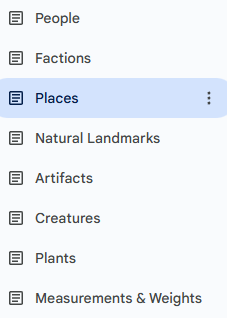
Each tab contains entries for every character, place, faction, landmark, etc. These entries include any description or essential information that comes up during the fiction. Except for the rare character, location, or landmark (usually one that came from a previously played game, like Jaggar, Dragonshadow Village, etc.), I only add information as it arises in the narrative. This cuts out a lot of front-end world-building, which would absolutely be an obstacle to ever writing the narrative for me. I often find that world-building is the part of TTRPGs that I enjoy the most. I can spend hours, even days, developing factions, locations, NPCs, weights and measurements, natural resources, and mythology. I, in fact, did just that in my first foray into Ironsworn: Sundered Isles. I have pages and pages of world-building notes, and I never got further than the first session. Some might consider that a wasted effort, but the joy of crafting a world is equally as valuable as anything else one might do in the TTRPG space.
The drawback to not world-building beforehand is that, though very rarely, some small bit of information will slip my mind and won’t get recorded. If you’ve ever seen any small inconsistencies in my writing it’s most likely from something like this. This isn’t a thing that happens often (as I’m quite anal about recording lore), but little things will inevitably slip through the cracks. If you’re using a program like Obsidian, it’s easy to put a link in text where the new thing appears for the first time. This automatically creates a page for you to go back and fill in when you’re finished playing. Google Docs, unfortunately, doesn’t have such a feature (that I’m aware of), so if you use that, perhaps immediately add the name or term to your reference section so you can at least search the document later to fill in the revealed details.
Maps As Lore
A secondary component of my lore-keeping, especially for the Iron Shorts, is keeping an updated copy of the world map. You don’t have to be an artist to do this. The map doesn’t have to be the pinnacle of fantasy cartography for it to be useful to you. All it needs to do is convey the locations important to your story.
The map I use for the Iron Shorts was originally created in 2023 using the map provided in the Ironsworn rulebook as a base. I took the general shape of the “official” Ironlands and made my own in Procreate. It started out with Dragonshadow Village, Wyvernwood, The Grimwood, Albon, Springfields, Khazu, and Firstmeet as the only locations. These came from my very first Ironsworn character’s adventures. I added Olgar’s Stand, Stonetower, and a few other places based on Jaggar’s adventures (my first published series, now available as an e-book) not long after. As I played more in this world, each new location got added to the map.
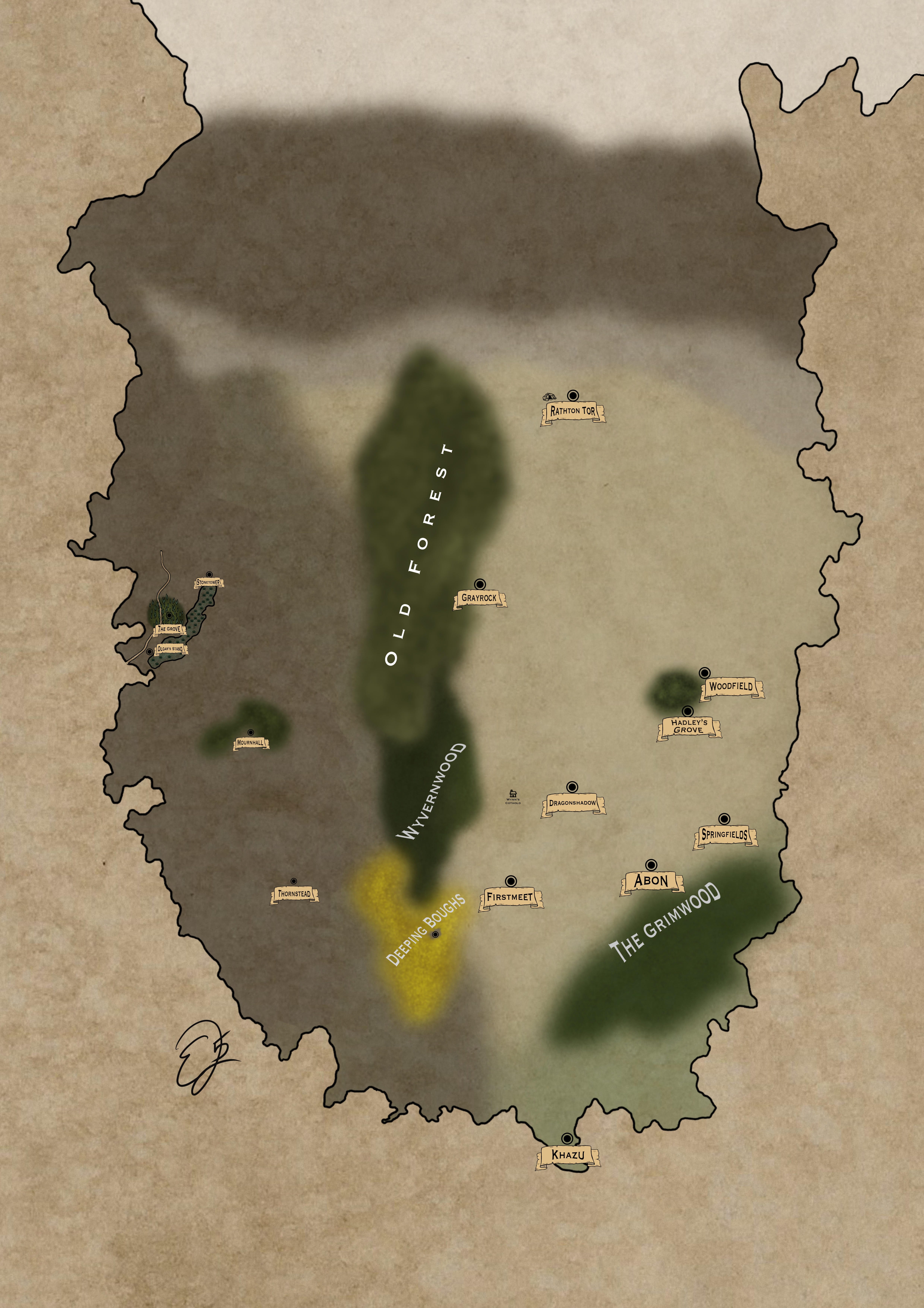
As you can see from the map, I denote towns with a dot in a circle (from the Map Effects Fantasy Map Builder). There’s no need for extreme detail in a map intended to help you know where people and things are. Forests are denoted by various colored blobs, sometimes with texture added. I haven’t included rivers for the most part, though I know where at least two are (but not their sources). Add those, if you want, with a semi-thick line. Ultimately, the goal is to be able to tell where important places and landmarks are in your world/story. As long as you can do that, your map is good.
Characters
Playing in a shared world means there is more than one player character to keep track of. Depending on the game you’re playing, this can range from complex (i.e. 5e) to simple (i.e. Four Against Darkness). Ironsworn falls somewhere in the middle, but closer to simple than complex. Tracking everything is important for those sessions where you want to bring a character back into the foreground. Since I play Ironsworn and its family of games most often, I don’t have trouble keeping track of inventories and the like since that isn’t a focus of the game. In a game like D&D or Dragonbane, however, forgetting to keep track of inventory could mean not having an item when you need it. You could add it, but that does come a little close to cheating for my comfort. This difficulty increases if you’re playing a party of active characters.
Since my experience is primarily with single, active PC games, I won’t provide much in the way of suggestions for playing parties here. The one suggestion I can add is to be careful of the game you choose to play if you’re running a full party. Four Against Darkness is pretty easy to play a party of four with relatively little book-keeping and has its own rules and instructions for forming a guild of adventures for rotating play (an Expanded Edition just released). A game like Castle Grief’s Kal-Arath is relatively light on the book-keeping and would be pretty easy to run a full party in solo.
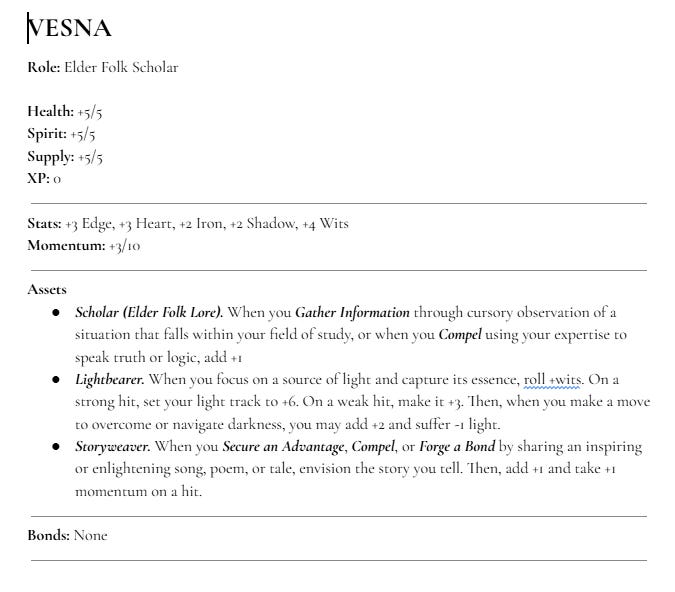
When playing my Iron Shorts, I kept track of the active character within the individual entries where they were the focus. Because I updated the character record each time it changed (i.e. losing/gaining health, spirit, supply, or momentum), whenever a character became the focus of a new entry, I could copy and paste from their last entry without worrying about needing to update information. Since almost every character was part of the overall narrative, even when they weren’t the point-of-view character, I didn’t reset momentum or other resources between entries unless there was a significant period of time between events where the character wasn’t an active participant (such as the time between Odvain’s first foray into the Firsborn tomb in Iron Short #1 and the initial attack on Rathton Tor in Iron Short #6).
The biggest difficulty in running Ironsworn in a sandbox-style world is deciding how to handle vows (the only means of gaining XP) and character progression. I often alter the vow mechanic to fit the setting. In my Sworn by Ghostlight series, I changed vows to investigations to fit the detective setting. Sometimes, I alter it to “quest” if I’m wanting to play a more traditional fantasy setting. This works just fine when playing a single character, but what about when each entry has a new/different point-of-view character? Therein lies the difficulty.
In the Iron Shorts, I often used the vows to dictate the general plot of the entry. For example, in Iron Short #4, the general plot was Keri (the POV character) searching the forest for the ingredients to make her mentor’s medicine. During the search for and return with the medicinal ingredients, I was able to build the character up, expand on the world, and establish points in the overarching plot of the series. She completed her vow, but I didn’t track experience. I knew that there would be very few characters who would take the helm multiple times, so there wasn’t much need for it. That works just fine in Ironsworn because there’s no “leveling up” involved. In other TTRPGs, xp leads to leveling up or otherwise earning mechanical bonuses. While Ironsworn assets provide a similar function, the stats of the character don’t increase upon gaining xp, so you’re not really stacking the deck against your character(s) as you might be in a game of D&D.
If, however, gaining xp and improving the character’s assets or purchasing new ones is important to you, I have a couple of suggestions. First, I find it helps to reskin vows as quests or tasks. This removes the swearing of a vow as a narrative focus and lets the vow take a backseat to the narrative you’re trying to tell. Then, any character that participates in the events of a session gains experience when the “Fulfill Your Vow” move is made. While they weren’t the point-of-view character, they still participated in accomplishing the task at hand and deserve to reap the rewards. In a long-term campaign, I would probably make non-point-of-view characters receive one rank less experience (minimum of 1xp) instead of getting the full reward in an attempt at maintaining some kind of balance.
Conclusion
While what I did with the Iron Shorts isn’t technically a West Marches-style campaign, the basic concepts can absolutely be used to play in a sandbox world with various characters. Letting the narrative lead your characters to interesting things is more important than woodenly following the rules to the letter, rolling for everything, and incorporating things that don’t really make sense or drive your story forward. Keeping track of where characters are, as well as what towns, natural landmarks, and important people they’ve encountered, etc. is absolutely essential in maintaining the world. If you’re like me, this is half the fun!
Thank you, Eric for your amazing insight as always. The message now is to go play in a shared world, Toad Warriors!
Links to DrivethruRPG are affiliate links. By clicking them and buying something you help the Lone Toad at no cost to yourself.